Mass-formation addresses: what they are, why companies use them, and what becomes of those companies
287 addresses were the registered office of 14% of the 2.5 million companies formed in the UK in 2022 to 2024. Companies registered at them are more likely to close early and less likely to trade. Most are genuine businesses using an ordinary service; here's what these addresses are, what the register shows about the companies at them, and why we count them separately.
Published 21 September 2026 · part of the UK Business Formation Index · free to quote with attribution to Salenovo · how to cite · downloads · for journalists
The short version
- 14% of new UK companies in 2022 to 2024 were registered at one of 287 addresses, each the registered office of 100 or more new companies in a single year. The ten busiest alone took 8.2%.
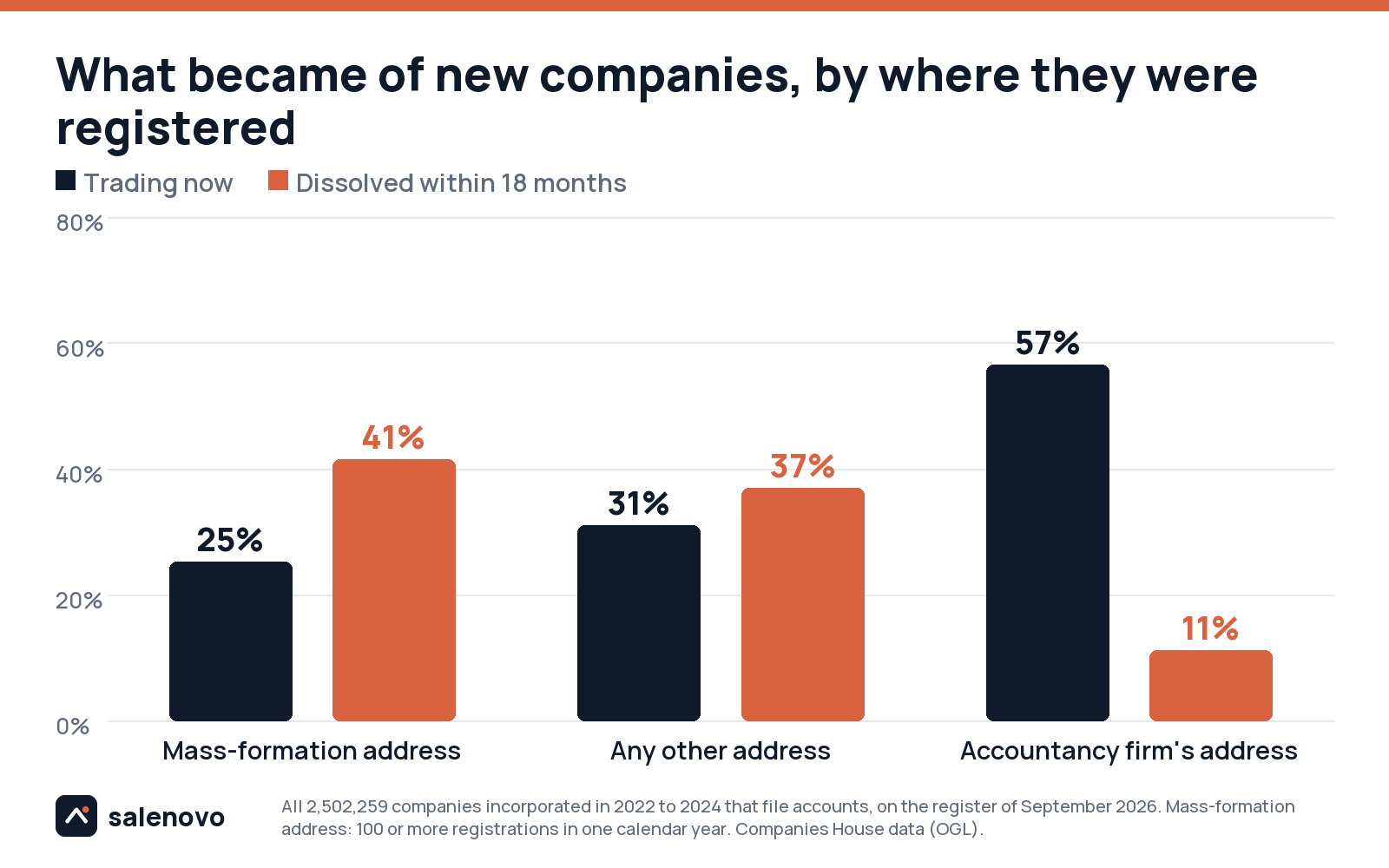
- 25% of the companies registered at them are trading today, against 31% at other addresses and 57% at an accountancy firm's address. 41% were dissolved within eighteen months.
- In London, 35% of new companies were registered at one of these addresses. Take them out and London's share of the UK's new companies falls from 31% to 24%.
- An address like this tells you how a company was set up, not whether it's genuine. It also tells you little about where the business actually works.
What a mass-formation address is
Every UK company has to give Companies House a registered office: the official address where letters from Companies House and HMRC are sent, shown on the public register for as long as the company exists. It doesn't have to be where the business works. Many companies use an address provided by someone else: a company formation agent, a virtual office, an accountant or a solicitor.
When one address is the registered office of hundreds or thousands of companies, we call it a mass-formation address. Our rule is simple and the same everywhere on this site: an address with 100 or more registrations in one calendar year. In 2022 to 2024 there were 287 of them, and the busiest was the registered office of 73,622 new companies in those three years. We don't name them: the finding is about a way of setting up a company, not about any business that provides the service.
Why companies use them
These are the reasons usually given, and they're mostly ordinary ones.
- It comes with the formation. Online formation services offer a registered office as part of the package, often for a few pounds a month. For someone setting up their first company it's the easiest option.
- Privacy. A registered office is public and stays on the register permanently. People running a business from home often don't want their home address published.
- A central address. A registered office in central London or another city centre can make a small business look established.
- Post handling. Official letters are received, scanned and forwarded, which suits businesses with no premises and people who move around.
- Founders outside the UK. A UK company must have a UK registered office, so founders based abroad need one. This is often given as a reason, but we can't measure it: it would need directors' nationality or residence, which we don't hold.
- Misuse. A small share of registrations aren't genuine businesses at all. Companies House's powers to query and remove false registrations were strengthened by the Economic Crime and Corporate Transparency Act 2023, and since March 2024 a registered office has had to be an "appropriate address": one where post will reach someone acting for the company, and not a PO box.
The register can't say which reason applies to any one company. What it does show is the kind of business registered at these addresses. Compared with companies at other addresses, these kinds of business were much more common at them:
- Packaging activities (82920): 7.4 times as common
- Other software publishing (58290): 3.7 times as common
- Business and domestic software development (62012): 2.5 times as common
- Dormant Company (99999): 2.3 times as common
- Agents involved in the sale of textiles, clothing, fur, footwear and leather goods (46160): 2.3 times as common
- Non-specialised wholesale trade (46900): 2.2 times as common
- Retail sale via mail order houses or via Internet (47910): 2.1 times as common
- Other business support service activities n.e.c (82990): 2.0 times as common
They're mostly businesses that need no premises: software, online selling and publishing, which fits the reasons above. Dormant companies, registered and never used, were also more common.
What becomes of the companies registered at them
We followed every company formed in the UK in 2022 to 2024, 2,502,259 of them, including the ones since dissolved, to the Companies House register of September 2026.
| Registered at | Companies | Trading now | Dissolved | Dissolved within 18 months |
|---|---|---|---|---|
| A mass-formation address | 361,147 | 25% | 61% | 41% |
| An accountancy firm's address | 305,915 | 57% | 26% | 11% |
| Any other address | 1,835,197 | 31% | 56% | 37% |
Companies incorporated in 2022 to 2024, on the Companies House register in September 2026. "Trading now" means still registered and filing trading accounts rather than dormant ones.
Companies at a mass-formation address were less likely to be trading and more likely to have closed, and much more likely to have closed early: 41% were dissolved within eighteen months, against 37% at other addresses and 11% at an accountancy firm's address. Setting up a company this way is quick and cheap, which makes it easy to try an idea and close it again, and some of the early closures are registrations that were never real.
The addresses differ a great deal. At a few the companies do as well as anywhere; at 77 of them, with 32,411 companies between them, 95% or more of the companies registered there have been dissolved.
Companies registered at an accountancy firm's address did best of the three. A company that has an accountant from the start is more likely to be a real, organised business.
Why it changes the picture of where businesses start
These addresses are concentrated in central London, so they inflate London's count of new companies. 31% of the UK's new companies in 2022 to 2024 had a London registered office. Leave out the mass-formation addresses and it's 24%. The single busiest address was the registered office of 9.4% of all the companies formed in London.
| Region or nation | Companies formed | At a mass-formation address |
|---|---|---|
| London | 786,593 | 35% |
| West Midlands | 207,094 | 9.5% |
| East of England | 204,683 | 8.2% |
| North West | 249,019 | 7.4% |
| South West | 125,674 | 5.1% |
| Scotland | 114,014 | 5.0% |
| Yorkshire and The Humber | 149,215 | 4.8% |
| East Midlands | 127,868 | 3.4% |
| South East | 258,997 | 2.1% |
| Wales | 59,547 | 1.0% |
| Northern Ireland | 40,164 | 0.7% |
| North East | 56,634 | 0.5% |
Regions for England; nations for Scotland, Wales and Northern Ireland. By the postcode of the registered office.
How Salenovo treats them
In the Formation Index. Wherever these addresses could inflate an area's figures, each page leads with the companies formed at their own address, and prints the share registered at a mass-formation or virtual-office address beside it. Survival figures for an area count own-address companies only, because the outcomes at an agent's address say more about the agent's customers than about the area. The expected-to-trade estimate gives each company at one of these addresses that address's own historical trading rate (the method page sets out how).
In the weekly ranked list. Companies at these addresses aren't removed. A subscriber gets every new company in their area. The address is one piece of evidence the ranking weighs, with how many other companies share it and what became of the companies formed there before. Because the addresses differ so much, the companies at them split to both ends of the ranking. Of the 7,701 we scored at a mass-formation address between 1 September 2026 and 20 September 2026, 20% were in the top band and 56% in the bottom one, against 13% and 8.1% of companies at other addresses.
In the accounts-due list. The companies with accounts due are the ones with their own registered address: not an accountant's, not a formation agent's. A company at an agent's address may still need an accountant, but the address tells you nothing about where to find it.
What it means if you work with new companies
For accountants, a client or prospect at one of these addresses is often a genuine business run from home or online. The registered office won't reach the owner in person, so the website, email or phone number is the way in. The early-closure figures are a reason to check a new company's filings and confirmation statement before relying on it.
For anyone reading formation statistics, the count of new companies in an area, and in London especially, depends on where formation agents happen to be based. Own-address counts are the better measure of local business activity.
Method, and what this doesn't show
The companies. Every company incorporated in England, Wales, Scotland and Northern Ireland in 2022, 2023 and 2024 that files accounts, 2,502,259 in all, including the ones since dissolved, with their status on the register of September 2026. Mass-formation address: 100 or more registrations in one calendar year, never a Companies House default address. Accountancy firm's address: the registered office of at least one accountancy firm on the register, and not a mass-formation address.
Latest address, not first address. Each company is counted at its latest registered office. A company that started at a formation agent's address and later moved to its own premises counts at its own premises, which, if anything, makes the companies at mass-formation addresses look worse than they were. Early on, moves are rare: of 12,438 companies formed at one of these addresses in June 2026, 0.4% had a different postcode three months later. Over three years more will have moved.
Trading is a register measure. "Trading now" means filing trading rather than dormant accounts. It isn't turnover or profit, and a company that files dormant accounts may still be preparing to trade. No reason is measured for any one company. The reasons above are the ones given by the industry and Companies House; the register records none of them.
Downloads
Cite this
Free to quote and reproduce with attribution. Suggested form:
To put the chart on your own page, with the credit built in:
The data are Companies House and ONS material under the Open Government Licence v3.0. A cut for any region or council is available on request: matt@salenovo.com.
Council-by-council survival and trading rates are at /survival/; the method, its accuracy and its agreement with ONS Business Demography at /method/. Every incorporation, weekly, by council: the Formation Index.