The £50 company fee cut new incorporations by 15%, and the number of new companies that go on to trade didn't fall
No official measurement has been published of what the May 2024 rise in the Companies House incorporation fee did. This one follows every company formed in the UK between 2022 and 2024 to what became of it: incorporations fell, more than half of the companies that stopped being formed would have been struck off within eighteen months, and the share of new companies that go on to trade rose from a third to two in five.
Published 1 October 2026 · part of the UK Business Formation Index · free to quote with attribution to Salenovo · how to cite · downloads · for journalists
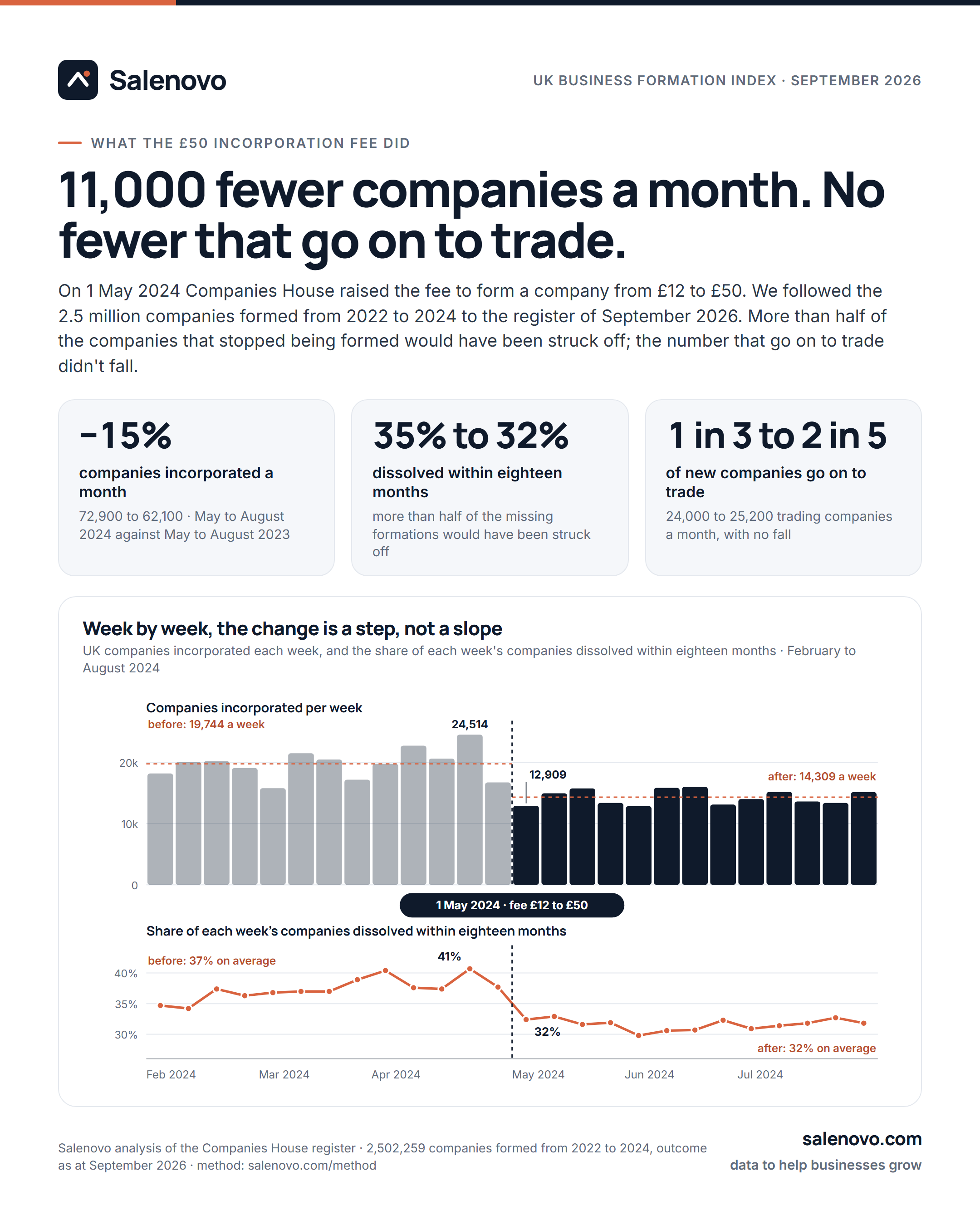
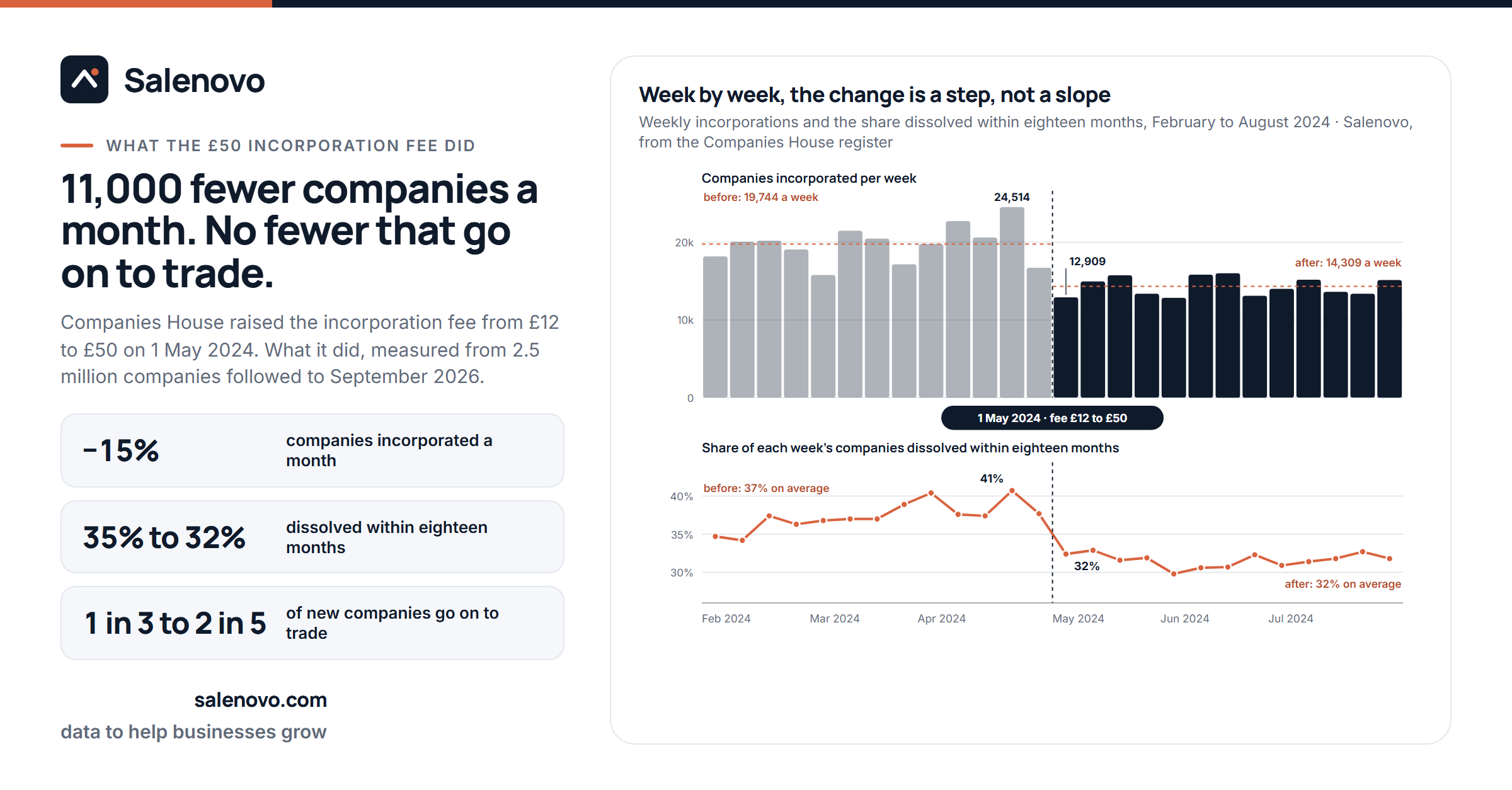
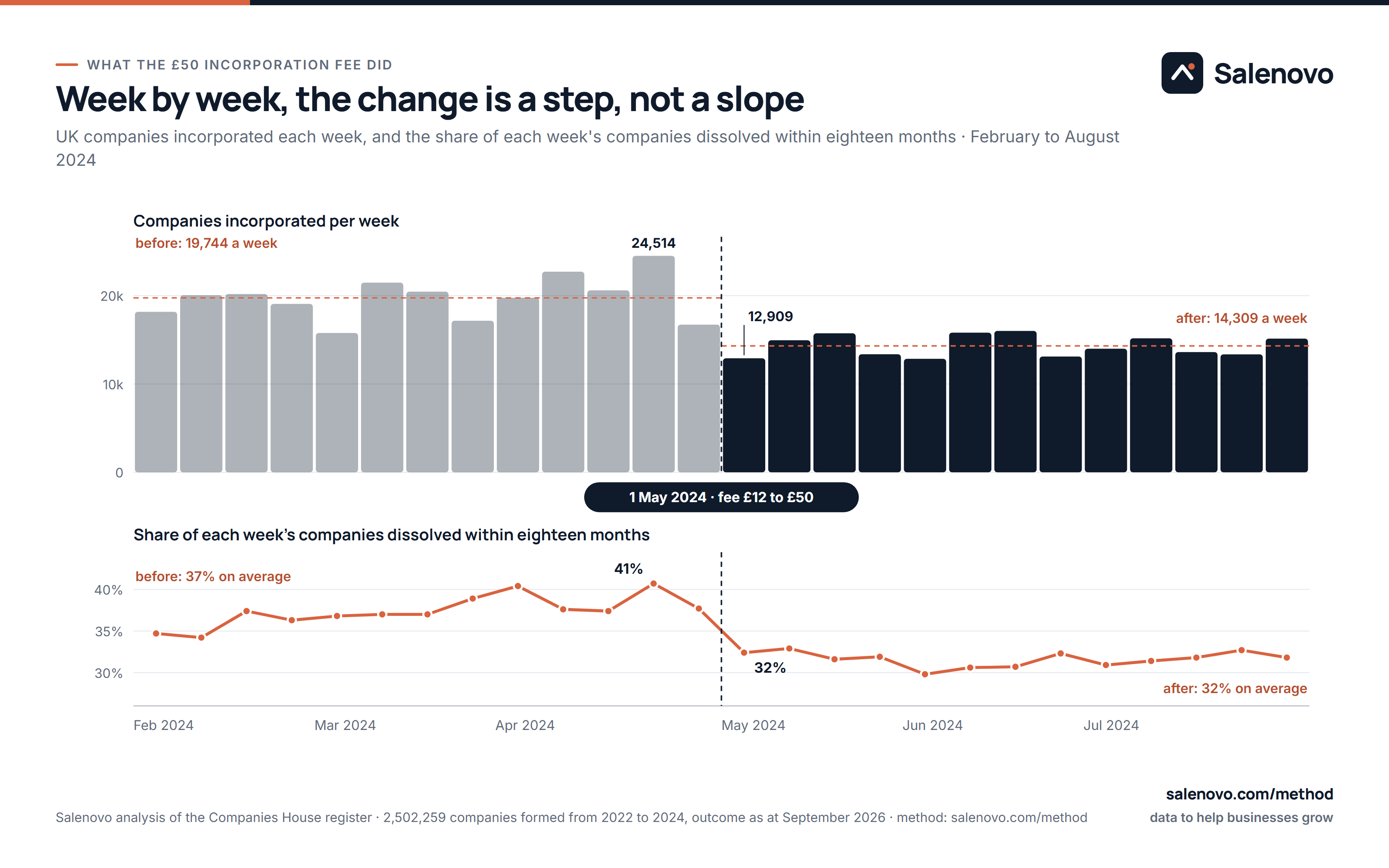
Week by week, the change is a step, not a slope
UK companies incorporated each week, and the share of each week's companies dissolved within eighteen months · February to August 2024
The weekly figures behind the chart
| Week of | Incorporated | Dissolved within 18 months | Went on to trade |
|---|---|---|---|
| 5 February 2024 | 18,173 | 34.7% | 36.6% |
| 12 February 2024 | 20,050 | 34.2% | 37.3% |
| 19 February 2024 | 20,192 | 37.4% | 35.2% |
| 26 February 2024 | 19,070 | 36.3% | 35.6% |
| 4 March 2024 | 15,774 | 36.8% | 35.6% |
| 11 March 2024 | 21,481 | 37.0% | 35.5% |
| 18 March 2024 | 20,452 | 37.0% | 34.9% |
| 25 March 2024 | 17,167 | 38.9% | 33.9% |
| 1 April 2024 | 19,766 | 40.4% | 32.5% |
| 8 April 2024 | 22,715 | 37.6% | 34.3% |
| 15 April 2024 | 20,604 | 37.4% | 33.6% |
| 22 April 2024 | 24,514 | 40.7% | 31.0% |
| 29 April 2024 | 16,716 | 37.7% | 34.1% |
| 6 May 2024 | 12,909 | 32.4% | 38.8% |
| 13 May 2024 | 14,952 | 32.9% | 38.7% |
| 20 May 2024 | 15,739 | 31.6% | 40.5% |
| 27 May 2024 | 13,368 | 31.9% | 40.2% |
| 3 June 2024 | 12,846 | 29.8% | 42.1% |
| 10 June 2024 | 15,819 | 30.6% | 41.5% |
| 17 June 2024 | 16,002 | 30.7% | 41.3% |
| 24 June 2024 | 13,104 | 32.3% | 40.4% |
| 1 July 2024 | 14,000 | 30.9% | 41.5% |
| 8 July 2024 | 15,166 | 31.4% | 41.1% |
| 15 July 2024 | 13,616 | 31.8% | 41.0% |
| 22 July 2024 | 13,361 | 32.7% | 39.8% |
| 29 July 2024 | 15,137 | 31.8% | 40.6% |
What happened
On 1 May 2024 Companies House raised the fee to incorporate a company online from £12 to £50. No official measurement has been published of what it did. Salenovo, which tracks every UK incorporation and what becomes of it, has followed the 2.5 million companies formed in 2022, 2023 and 2024 through to the register of September 2026. The answer is unusually clean.
Fewer companies were formed. In the four months after the change, 62,100 companies a month were incorporated against 72,900 in the same months of 2023 (15% fewer, about 11,000 a month) and 86,000 a month in the four months before it, when formations were swollen by a rush to beat the deadline (97,991 in April 2024 alone, the busiest month of the three years studied). Week by week the break is a step, not a slope: 24,514 companies in the last full week of April, 12,909 in the first full week of May, and between 12,800 and 16,000 in every week after it to the end of July.
More than half of the missing companies would have been struck off. Of the companies formed in May to August 2023, 35% had been dissolved within eighteen months, nearly all of them struck off by the registrar for never filing a confirmation statement. Of those formed in May to August 2024, 32% were. Against the same months a year earlier the missing 11,000 companies a month were about 6,000 that would have been dissolved within eighteen months and about 4,800 that would have survived on the register. The number of new companies that went on to trade didn't fall: 24,000 a month before, 25,200 after.
So the share of new companies that go on to trade rose. In every month from January 2023 to April 2024, between 31% and 36% of new companies went on to trade. From May 2024 the figure is 38% to 42% in every month and every week to the end of the data (July 2024). Companies formed at mass-formation agents' addresses fell faster than the rest, by about a quarter against the same months of 2023, and their share of formations went from 15.5% to 13.5% (it was 14.0% in the four months before the change). But companies formed at their own address fell by about an eighth too, so this isn't only agents leaving the market; it's marginal formations (the ones a £12 fee didn't deter and a £50 one does) not happening.
Part of the change isn't the fee. The Economic Crime and Corporate Transparency Act gave the registrar new powers in March 2024, and from late 2024 Companies House began replacing the registered offices of companies with bogus addresses and striking them off: 115,741 of the companies in this cohort ended that way. Those bogus-address companies fall from about 9 or 10% of each month's formations to 4% at exactly May 2024. Against the four months before the change (38.0% to 31.8%), excluding them the fall is 30.5% to 27.9%: about half of that fall is the fee, half the registrar's programme.
“For as long as anyone has counted, a third of new UK companies have gone on to trade and two-thirds haven't. That was the number the whole system was built around, and it moved on one day in May 2024. The interesting thing is what didn't move: the number of real businesses being started is the same as it was. More than half of the companies the fee took out were paperwork companies, and the businesses kept coming.”
Matt Vallis, founder, Salenovo
Why it matters. Companies House data is used as a proxy for business creation by councils, growth hubs, banks and the press. In the months after the change the raw incorporation count was about 15% lower than a year earlier, and the count means something different: a new company is now materially more likely to be a business. Comparisons of 2025 formation figures with 2023 that don't account for the change will read a cleaner register as a downturn.
Key figures
| May to Aug 2023 | Jan to Apr 2024 | May to Aug 2024 | |
|---|---|---|---|
| Companies incorporated per month | 72,900 | 86,000 (April: 97,991) | 62,100 |
| Dissolved within eighteen months | 35.3% | 38.0% | 31.8% |
| Went on to trade | 32.9% | 34.1% | 40.5% |
| Companies that went on to trade, per month | 24,000 | n/a | 25,200 |
| Formed through a mass-formation agent | 15.5% | 14.0% | 13.5% |
Thirteen weeks before the change: 19,744 companies a week, 37.4% dissolved within eighteen months, 34.6% went on to trade. Thirteen weeks after: 14,309 a week, 31.6% and 40.6%.
Method and caveats
Source and method. Salenovo follows every company incorporated in the UK from the day it appears on the Companies House register. This analysis covers the 2,502,259 companies incorporated between 1 January 2022 and 31 December 2024 (99.5% of the register's own count once overseas entities are excluded), with each company's status on the register as at September 2026. "Dissolved within eighteen months" is measured for every company in the cohort, all of which had reached eighteen months by the September 2026 register. "Went on to trade" means the company was still active on the September 2026 register and its latest accounts were trading accounts, not dormant ones. A company that traded and was later dissolved doesn't count, and companies formed in 2023 had a year longer to close than those formed in 2024, so part of the rise in the trading share may be that extra year. The method, its accuracy and its agreement with ONS Business Demography at national, regional and council level are published at salenovo.com/method/. Council-by-council figures are at salenovo.com/survival/ and as CSV.
Caveats we ask you to carry. (1) Dissolved isn't "failed": most of these companies never traded, and were struck off at seventeen months for never filing a confirmation statement. (2) The change coincides with the registrar's new ECCTA powers; against the four months before the change, about half of the fall in dissolutions is the fee and half the registrar's bogus-address programme. (3) The trading share of companies formed after September 2024 can't yet be compared: many haven't reached their first accounts date. (4) These are companies, not businesses: ONS Business Demography counts VAT/PAYE-registered enterprises, a different and smaller population. (5) The week of 29 April 2024 spans the change and is shown as one bar. (6) The local figures count companies formed at their own address, and an address with fewer than 100 registrations a year counts as one. A cluster of registrations just below that line can move a single constituency or council, so a large local rise or fall is worth checking before it's reported.
Downloads
Cite this
Free to quote and reproduce with attribution. Suggested form:
To put the chart on your own page, with the credit built in:
The data are Companies House and ONS material under the Open Government Licence v3.0. A cut for any region or council is available on request: matt@salenovo.com.
Council-by-council survival and trading rates are at /survival/; the method, its accuracy and its agreement with ONS Business Demography at /method/. Every incorporation, weekly, by council: the Formation Index.